Surviving the "AI Job Apocalypse": Actionable Upskilling for Developers
by Simarpreet Singh
1. The Reality Check: Is the AI Job Apocalypse Real?
The anxiety is palpable. Across Twitter (X), LinkedIn, and developers' forums, the sentiment keeps oscillating between unbridled enthusiasm and profound dread. When the CEO of Anthropic openly predicts that a significant percentage of tasks — and consequently, jobs — could be replaced by advancing AI models over the next few years, the economic anxiety in the developer community skyrockets.
But here's the unvarnished truth: AI is not going to replace software engineers entirely. However, software engineers who use AI will absolutely replace those who don’t. We are currently experiencing an industrial revolution tailored to knowledge work. The 'AI Job Apocalypse' isn't about the extinction of developers; it's about the extinction of the inflexible coder. If your entire value proposition is just translating well-defined Jira tickets into basic CRUD boilerplate, you are in the high-risk zone.
2. The Mindset Shift: From AI Consumer to AI Builder
The first step to surviving this shift isn't learning a new syntax; it's changing your mindset. The vast majority of developers right now are merely AI Consumers. They paste their bugs into ChatGPT, use GitHub Copilot as a glorified autocomplete, and maybe generate some regex. That is baseline survival. It's the equivalent of knowing how to use a microwave.
To secure your career, you must transition into an AI Builder. An AI builder understands how the microwave actually generates heat. They don’t just ask ChatGPT for a solution; they leverage APIs to embed LLMs into applications. They fine-tune open-source models on proprietary data. They architect systems where AI agents handle autonomous tasks. You have to move from sitting in the passenger seat to taking control of the engine.
3. The Core Learning Path: What Actually Matters
You don't need a PhD in Mathematics to get started, but you do need to understand the fundamental mechanics. Focus your upskilling efforts on these three pillars:
Applied Machine Learning Basics: Understand the difference between supervised vs. unsupervised learning, vector embeddings, and the concept of loss functions. You don't need to write the math from scratch, but you need to know what the concepts represent.
Understanding Transformers: The architecture powering modern GenAI. Grasp how attention mechanisms work and how tokenization impacts both cost and context limits.
Advanced Prompt Engineering & RAG: Don't just learn 'hacks'. Learn how to implement Retrieval-Augmented Generation (RAG) robustly. Learn about vector databases (like Pinecone or ChromaDB) and how to ground LLM responses in factual, targeted data.
Real-World Application: Adding AI to Your Stack
Theory only gets you so far. The defining characteristic of a senior AI-integrated developer is practical execution. Let's look at concrete examples of how traditional developers are proving their worth.
Example 1: The AI-Enhanced SaaS Controller
Imagine you maintain a standard, multi-tenant SaaS application—like a restaurant management system built with Node.js and React. A traditional developer builds an inventory tracking page.
An AI Builder integrates the OpenAI API via backend cron jobs to continually analyze inventory movement patterns. Instead of just showing stock levels, the application predicts shortages a week in advance based on historical API data, local events, and weather patterns. Furthermore, they implement a semantic search endpoint so restaurant owners can type 'Show me ingredients expiring this week that we use in our top three selling dishes,' and receive immediate, actionable intelligence instead of navigating through five complex filter menus.
Example 2: The Humanizing Resume Parser
Most career platforms use notoriously rigid keyword matchers that frustrate applicants. As an AI Builder, you can replace standard regex-based CV parsing with an LLM pipeline. When a user uploads a PDF, you use LangChain to extract the text, chunk it, and pass it to an instruction-tuned model. The prompt doesn’t just map keywords; it evaluates the impact of the bullet points and automatically suggests 'humanized', more professional re-writes of overly technical jargon to appeal directly to HR recruiters.
4. Local AI Development: The Tech Edge
One of the biggest misconceptions is that getting into AI development requires access to an AWS supercluster and enterprise funding. In reality, the cutting edge of applied AI is shifting rapidly to the local edge.
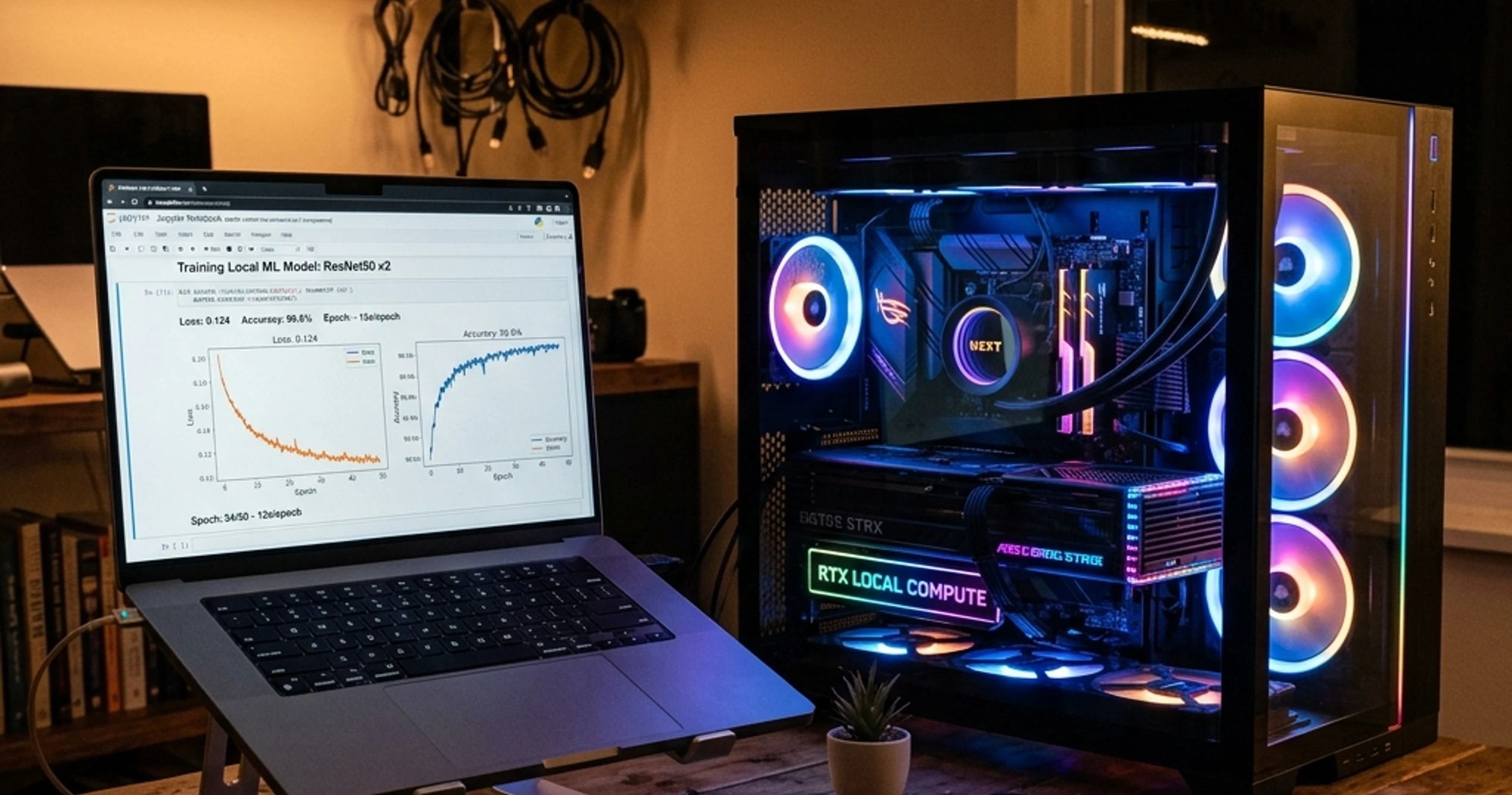
Developers can train, fine-tune, and run open-source models right on their home setups. You don't need an exorbitant cloud contract. By utilizing models like Meta's Llama 3 8B, you get GPT-3.5 level performance (and often better on specialized tasks) running entirely locally.
Fine-Tuning on Consumer Hardware
With optimizations like QLoRA (Quantized Low-Rank Adaptation), you can explicitly fine-tune high-level models efficiently on consumer-grade hardware like an NVIDIA GTX 4060 with just 12GB (or even 8GB) of VRAM.
Tools like Unsloth and the Hugging Face ecosystem make this incredibly accessible. You can format a specific dataset (like domain-specific code or proprietary company documentation), spin up a Jupyter Notebook locally, and complete a training run in a matter of hours. This capability—taking a generalized open-source model and perfectly adapting it to a company's specific, private use case without sending data to OpenAI—is currently one of the most lucrative skills in the tech industry.
5. Recommended Projects for Your Portfolio
To prove you are an AI Builder, you need code in production. Avoid building 'another ChatGPT clone UI'. Build these instead:
Local RAG Application Over Personal Documents: Build a system using LangChain, a local ChromaDB instance, and Ollama. Feed it your personal notes, PDF textbooks, or codebase. Create a UI that lets you query your own private knowledge base 100% offline.
Automated Multi-Agent Workflow Script: Use Python and a framework like AutoGen or CrewAI. Create a script where one AI agent scours GitHub for popular repositories in your niche, a second agent evaluates the code quality, and a third agent drafts a summary report of trends, saving it to a markdown file.
Fine-Tuned Specialized Classifier: Collect 500 rows of very specific text data (e.g., customer support tickets categorized by urgency). Use Unsloth to fine-tune Llama 3 on this data locally. Build a simple FastAPI endpoint around the fine-tuned model that accepts new tickets and returns the category.
6. Conclusion & Call to Action
The 'AI Job Apocalypse' is largely a narrative of transition, not termination. The developers who act decisively right now—shifting from passive consumers to proactive builders, mastering local fine-tuning, and integrating AI into real-world applications—are the ones who will write the next chapter of the tech industry. You have the tools, the consumer-grade hardware is capable, and the open-source community provides the rest. The only missing variable is execution.
Take control of your career trajectory today. Drop a comment below: What is the first real-world problem you plan to solve using your new AI skills this weekend?
FAQs
Will AI completely replace software engineers?
No. It automates coding tasks, but it doesn't replace the need for architectural design, system integration, security, and solving complex business problems. AI is a powerful multiplier, not a direct replacement. It replaces coders who refuse to adapt.
Do I need a math degree to get started?
Absolutely not. You can start building by utilizing high-level APIs (OpenAI, Anthropic) and orchestration tools (LangChain, LlamaIndex). Learn applied AI first. You can dive into the linear algebra and calculus later if you decide you want to build custom model architectures from scratch.
What programming language should I focus on?
Python is currently the undisputed king of the AI ecosystem. Virtually all major frameworks, documentation, and research are Python-first. However, JavaScript/TypeScript are incredibly crucial for full-stack integration, building the actual user interfaces, and bridging edge deployments through tools like Vercel AI SDK.